Many links on this page go to the abbreviation glossary which is in ILo, not in English.
How can I get more information about the AIS
The International Academy of Sciences (Akademio Internacia de la Sciencoj, AIS) San Marino is a common arena for professionally notable and linguistically progressive scientists from all over the world, who strive for greater efficiency in research and teaching in all sciences, and for closer contact of the latter with technology and art, by enhancing international communication and interdisciplinary co-operation.
The members (MdAIS), as well as the associated, effective members (AMdAIS) and the adjuncts (AdAIS) belong to different nations, continents, races, religions, linguistic regions, and political camps. The political pluralism of these affiliates guarantees the strict political neutrality of the AIS, except for its only common political goal: to realize, little by little, the basic human right to communication without hindrance either by language barriers or language discrimination.
The AIS does not restrict itself to some of the sciences (this is why, in ILo, it is called “Akademio de la Sciencoj”, rather than “de Sciencoj") but is in principle open to any field of systematic research where it is desired and conceivable to gain knowledge valid independently of linguistic, racial, political, religious, or other membership. Therefore the sections and departments of the AIS, while aiming at a complete modern classification of all sciences, do not cover theology nor any analogous doctrine of any religion, but do comprise comparative theology and religious history.
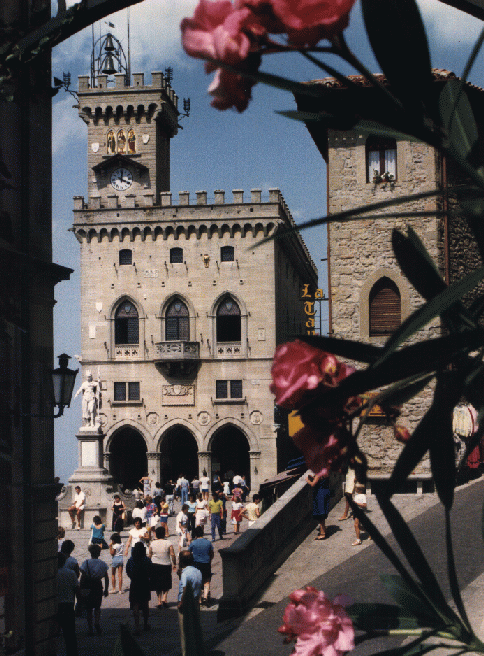
The AIS is a free institution in the free republic of San Marino, a small European country. The state of San Marino provides a legal platform and some material help but does not interfere with the freedom of scientific teaching and research.
Although the International Academy of Sciences (AIS), according to article 4 of its statute, “takes special care of the application of the Internacia Lingvo in scientific communication and in culture”, it neither wants to nor can it replace the Akademio de Esperanto or any other organisation of the Esperanto movement.
Even though the only working language of the Senate, the General Assembly and the examination committees of the AIS is ILo, the Internacia Lingvo of Dr. Esperanto, the Statuteadditionally declares the four ethnic languages with the richest tradition in European history as official languages of the AIS, namely English, French, German, and Italian.
The heads of the AIS are aware that the aims of the Esperanto movement surpass those of the Academy, which are restricted to the fields of science and, secondarily, of art and technology. Therefore AIS in no way aims to rival the Esperanto movement or to force the complete cultural heritage of the latter upon the members and adjuncts of the Academy. Quite a few university researchers use the language initiated by Dr. Zamenhof in 1887 in their scientific work because of the precision, conciseness, ease of learning and neutrality of this most successful of the living planned languages but they nevertheless do not think of themselves as Esperantists already for doing so.
This division from the Esperanto movement AIS highlights the compromise proclaimed on the occasion of the solemn inauguration of the First “Sanmarinian University Session" (SUS 1) on December 28, 1983: AIS uses as the name of Zamenhof's language not the initiator's pseudonym but the original name “Internacia Lingvo”, frequently abbreviated “ILo”.
At the suggestion of scientist from the “Eŭropa Klubo”, the Sanmarinian Minister of Education and Culture, Dr. Fausta Morganti, presented a motion about the foundation of the Academy, approved by the “Congresso di Stato” in its decision no. 58 on May 19, 1983. The promotion committee AIS of the Eŭropa Klubo prepared the first Sanmarinian University Session (SUS 1). During this conference, by which the scientific activity of the AIS effectively started already in 1983, the International Scientifique College (Internacia Scienca Kolegio, ISK), was established as a base for this scientific activity.
On September 13, 1985, AIS was officially established by notarial signing of the Statute, and on October 1985 ("1685 after the foundation of the Republic"), the Great and General Council of the Republic of San Marino approved the legal framework on university teaching and institutions of higher education, now making possible the official acknowledgement of the Academy's teaching activities without infringing its internationality and independence.
This way, on the basis of detailed examination regulations, and the judgement of a multinational committee, AIS can acknowledge graduations from universities or other academic institutions conferring an international scientific degree:
These degrees may also be qualified for originally, studying and taking exams mainly with lecturers of the AIS.
In addition to the legal and material support that the AIS enjoys thanks to the Republic of San Marino, it is supported
The AIS consists of its Supporting Members (SMdAIS) and the members of the International Scientific College (ISKanoj) appointed by the Senate (as well as the members of the International College of Arts, called IAKanoj, and of the International College of Technology, ITKanoj). It is welcome to be an ISKano and at the same time a supporting member.
The AIS regularly organizes
The Scientific Sector is divided in six sections or faculties, each led by a dean.
The collaborators of the Scientific Sector